The Stanley Cup: A History of Abuse and Neglect
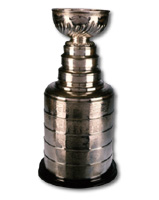
"One of the great rules of hockey is: On the Stanley Cup, all germs are healthy." --George Vecsey, The New York Times, June 11, 1999
I got to touch the Stanley Cup. Me. I've ice skated only once in my life, I've never played a real game of hockey, I hadn't even seen a hockey game on television until high school (1990) and I didn't see one in person until January 1999. Still, I touched something that I imagine most serious hockey players don't get to touch their entire lives--the oldest trophy that can be won by professional athletes in North America, the Stanley Cup.
How did this I get to touch the cup? In 1998, the Detroit Red Wings won their second consecutive Cup. Every member of the winning team gets the Cup and its entourage of bodyguards for twenty-four hours in the subsequent summer. One of the Red Wings on that '98 team, Grand Rapids Michigan-native Mike Knuble (actually, he's from the Grand Rapids suburb of Kentwood, but why fret over details?), brought the Cup to his old high school, East Kentwood High School. Though I write these words in Chicago, I'm originally from Grand Rapids, and I happened to be in town the same time as the Cup. Up to 500 fans (four of whom were me, my sister Michelle, and my cousins Adam and Kristy) were, upon paying an admission fee, allowed to touch it and take a snapshot or two with it and spend a grand total of maybe 10 seconds with the Cup.
(Good thing I took the chance when I had it. Three weeks after he came with the Cup, Mike Knuble was traded away from the Wings to the New York Rangers.)
In my few seconds with the Cup, the thing that struck me most about it was that it felt...fragile. The Stanley Cup had a consistency that honestly made me think of tin foil, thin and not the least bit resilient. I know otherwise that it's plenty resilient, but still I couldn't help but be astonished and think that this trophy, probably more than any other trophy in history, went To Hell And Back.
The fact that it has makes its history all the more amazing.
The Stanley behind the Stanley Cup was Lord Stanley of Preston, the Governor General of Canada (the Queen's Representative to the Dominion of Canada), the sixth in the long regal line. If you think that's a mouthful, Stanley's full title was the Monty-Python-esque "Right Honourable Sir Frederick Arthur Stanley, Baron Stanley of Preston, in the County of Lancaster, in the Peerage of Great Britain, Knight Grand Cross of the Most Honourable Order of the Bath." (inhale)
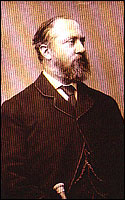 Stan The Man became
interested in hockey during his stint as Governor General from 1888 to 1893.
He offered to pay 10 guineas for a trophy to be used as a challenge cup
rewarding the best amateur hockey teams in Canada and first awarded for the
1893-94 hockey season. (Depending on the source you look at, that 10 guineas
amounts to either $48.33 or $48.67. Canadian cash, remember.)
Stan The Man became
interested in hockey during his stint as Governor General from 1888 to 1893.
He offered to pay 10 guineas for a trophy to be used as a challenge cup
rewarding the best amateur hockey teams in Canada and first awarded for the
1893-94 hockey season. (Depending on the source you look at, that 10 guineas
amounts to either $48.33 or $48.67. Canadian cash, remember.)
An Aide to Stanley bought the Cup itself, which (depending on the source) was made by a silversmith or silversmiths (we don't know who they were) from London or Sheffield. The Cup was more like a bowl--a gold-lined silver bowl on an ebony base, measuring seven inches high and 11-1/2-inches in diameter. (One source lists the original height at 7 1/2 inches.) For about 40 years, Lord Stanley's silver bowl was the entire trophy, but players on championship teams began scratching their initials on the bowl. In response, sometime in the 1940s silver bands were added to the bottom of the bowl with all the names on winning teams engraved on them. The trophy grew to its present height of 35-1/4 inches (or 35-1/2 inches, depending on the source or the ruler) with a base 54 inches in circumferences. It weighs 32 pounds, though, in the words of an ESPN sportscaster, "when you win it, it is but a feather."
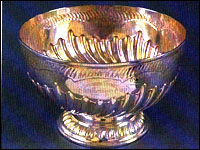
Though Stanley wanted his Cup to be the domain of amateur hockey players, professional leagues would eventually elbow their way in. (Amateur teams competed for the Cup until 1910, when the professional National Hockey Association (NHA) was formed, which in 1917 became the National Hockey League (NHL), whose teams competed for the Cup against teams from other [mostly western] pro leagues until 1926. By that time, the other leagues had folded, thus making the Stanley Cup the exclusive domain of the NHL.) In fact, Lord Stanley, later Earl of Derby, returned to England ten months before the first Stanley Cup playoff. Ironically, he never saw a Stanley Cup game.
Lord Stanley effectively abandoned his Cup. He wouldn't be the last person to do so.
OTTAWA, 1903. A member of Ottawa's Silver Seven took the Cup home. The teammates found out, a scuffle ensued, and the Cup was tossed into a cemetery.
OTTAWA, 1905. After the Ottawa Silver Seven won the Stanley Cup, one celebrant boasted he could kick it across the frozen-at-the-time Rideau Canal (which links Ottawa on the Ottawa River with Kingston on Lake Ontario). In a day when the Cup was a football-sized bowl and when most hockey players also played rugby, he proceeded to drop kick it into the frozen canal. (Some sources list it as being submerged, however read on.) The partyers proceeded to party elsewhere, leaving the Cup behind. The next morning, the players realized that the Cup was still at the Canal, so they headed to recover the Cup and fortunately found it right where they left it On Colden Pond (or canal).
Abandonment came, abuse (or at least some really weird treatment) followed.
MONTREAL(?), 1906 or 1907. A Montreal club (possibly the Wanderers) wanted its picture taken with the Cup in the studio of photographer Jimmy Rice. After taking the photo, the team left, and the team left behind the Cup. It stayed in the studio for some months until Rice's mother (some sources say it was his wife or his housekeeper or his cleaning lady) used it as a vase, as it held red geraniums in the Studio window.
KENORA (?), ONTARIO, 1907. The Kenora Thistles were forbidden to use two players in the 1907 series. A team official took the Cup and said, "I'm going to throw it in Lake of the Woods." He didn't.
MONTREAL, CIRCA 1910. One of the then-champion Montreal Wanderers operated a St. Catherine Street Bowling Alley, where the Cup was "lodged in a showcase, heaped big with chewing gum to entice prospective buyers."
MONTREAL, 1924. The Montreal Canadiens went to Leo Dandurand's home for a champagne party. The car carrying the Cup had tire blow out, and the car's occupants put it on the side of the road while they stopped for repairs. After the repair, they drove off without the Cup. They realized this when only when they arrived at their destination, and they immediately left to retrace their route to try to find the Cup. They found it a mile and a half away from Dandurand's home--exactly where they left it.
OTTAWA, 1927. The Ottawa Senators won it, and it spent much of the year's summer in King Clancy's living room, where it served as a receptacle for everthing including letters, bills, chewing gum, and cigar butts.
NEW YORK CITY (?), 1940. After the New York Rangers won the cup, Hall of Famer Lynn Patrick and teammates celebrated by urinating in it.
MONTREAL, 1947. With Montreal trailing three games to two in the best-of-seven Cup final, Conn Smythe left the Cup in Montreal after the fifth game of the finals even though game six was slated for Toronto. This would make easier the celebration of a game seven win in Montreal. Problem is, Toronto won game six at Maple Leaf Gardens, thereby winning the Cup which was still in Montreal.
CHICAGO, 1962. When the Montreal Canadiens were losing in the playoff semifinals to the then-defending-Cup-champion Chicago Blackhawks, a Montreal fan went to the the Chicago-Stadium-lobby display case where the Cup was kept, took the Cup and headed for the door. The thief almost reached the street before being stopped by a stadium police officer Later, the fan said "I was taking the Cup back to Montreal, where it belongs."
TORONTO, LATE 1960s and 1970. The Cup was stolen twice from Hockey Hall of Fame in the late 1960s. (On December 5, 1970, Burglars stole the Cup along with the Conn Smythe trophy and the Bill Masterston Memorial Trophy.) Police would recover the trophies each time. One thief threatened to throw the Cup into Lake Ontario unless the charges were dropped.
NEW YORK CITY(?), 1980. Clark Gillies of the 1980 New York Islanders allowed his dog to eat from it. Gillies said, "He's a nice dog." Islander Bryan Trottier took the Cup with him to bed. He said, "I wanted to wake up and find it right beside me. I didn't want to think I'd just dreamed of this happening."
MONTREAL(?), 1986. Chris Nilan of the champion Canadiens photographed the Cup in 1986 with his infant son in it. Nilan said, "His bottom fit right in."
EDMONTON, 1987. The night after the Edmonton Oilers won the Cup, one of them [likely Mark Messier] placed it on stage with an exotic dancer at the Forum Inn, an Edmonton strip joint just across the street from the Northlands Coliseum. Messier took the Cup to various night spots and let fans drink from it.
BOSTON, 1988. During the 1988 finals, two Harvard seniors served as security and guarded the Cup in Boston's Ritz-Carlton hotel.
NEW YORK CITY, 1994. New Yorkers savored the Cup when the Rangers won for the first time in 54 years. As Sports illustrated told it: "Like a loose puck it has been slapped from bar to nightclub to ballpark to ballroom to racetrack to squad car to firehouse to strip joint. Along the way it has been kissed, petted, hugged, massaged, fondled and shaken in exultation by thousands of fans. Many have taken sips from its ample bowl. 'God only knows whose lips have been on that thing,' says Bruce Lifrieri, the Rangers' massage therapist. " The litany of hijinks in New York alone deserves a webpage of its own: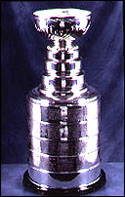
Mark Messier and Brian Leetch brought the Cup on The Late Show with David Letterman and did Stupid Cup Tricks.
Ed Olczyk brought it to Belmont racetrack and let 1994-Kentucky Derby winner Go for Gin use it as a feed bag.
Brian Noonan and Nick Kypreos brought the Cup on MTV Prime Time Beach House where it was stuffed with raw clams and oysters. (On the show, Noonan denied he had used the Cup as a rolling pin to make muffins. Kypreos denied playing kick the can with it.)
Messier took the Cup to Scores, an East Side strip joint. Scores spokesman Lonnie Hanover said, "It was the first time I'd seen our customers eager to touch something besides our dancers,"
The Cup went to a Ranger victory party at a Manhattan saloon called the Auction House, where it stopped traffic, started parades, and was drunk out of by everyone in sight until the bar was effectively down to backwash (but that probably wouldn't have stopped them).
After a ticker-tape parade up Broadway, and some time at McSorley's bar, a cop named Jim Jones (different guy) strapped a seat belt around the Cup in his squad car and delivered it to another engagement.
The Cup was taken to a Yankees game at Yankee Stadium, where it watched the game from George Steinbrenner's luxury box. The Yankee fans at the game cheered "Let's Go Rangers!" (That same day, the Cup visited Brian Bluver, a 13-year-old patient awaiting a heart transplant at Columbia-Presbyterian Medical Center. According to his father, Brian "smiled for the first time in seven weeks". A week and a half later Brian had 11th-hour heart surgery.)
The enthusiasm was so great that Stanley went in to a Montreal silversmith to repair its cracked bowl, loose base, and dented body. (It wasn't the first time--after a rough-and-tumble summer with the Oilers in 1988, the Cup went in to an auto body shop for reconstructive surgery. Messier really knows how to bang up a trophy.)
Indeed, in the words of Sport Illustrated's Franz Lidz, "Roughhousing is part of the trophy's tradition."
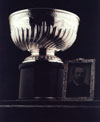
The Cup was reputedly dismantled (by whom, when, where, how and for how long, I don't know--though it might have been done on numerous occasions).
The Cup was reputedly used as a peanut dish (by whom, when and where, I don't know--though it might have been done on numerous occasions).
In 1991, The Cup was found at the bottom of Pittsburgh Penguin Mario Lemieux's swimming pool. (Lemieux also once brought the Cup with him to bed.)
It was reputedly dumped in a snowdrift (by whom, when and where, I don't know--though it might have been done on numerous occasions).
The Cup has starred in its own beer commercial.
The Cup also lay at the bottom of Patrick Roy's pool.
Stefan Lefebrve had his son baptized in the Cup.
During the two summers of 1997 and 1998 when the Red Wings won the cup, the Cup went golfing with Darren McCarty, to the shower with Steve Yzerman, bo[wl]ing with Martin Lapointe and visited Moscow with Slava Fetisov, Slava Kozlov, and Igor Larionov.
In the 1990's, the Cup would pay other visits overseas. In 1996, it went to a European player's home for the first time--Ornskoldvik, Sweden, with Colorado player Peter Forsberg. However, the following AP report appeared in the July 27, 1999, New York Times: "For the first time in its history, the Stanley Cup has traveled outside North America or Russia, landing in Prague yesterday. The trophy was taken over for a day by Czech goalie Roman Turek, a member of [the 1999] Stanley Cup-winning Dallas [Asterisks--I mean] Stars. Turek said he would take the cup to to his hometown of Ceske Budejovice, 100 miles south of Prague. The cup, guarded by two National Hockey League bodyguards who arrived with it, will be exhibited at the main square of the town of 100,000."
AND TODAY.... As alluded to above, the Cup now has its own entourage. After the Rangers and their fans had their fun with the cup in 1994, the NHL--angry over the repairs that were required--mandated a round-the-clock security force. They're called the "cup cops", at least one of whom is supposed to accompany the Cup at all times. It appears the "neglect" chapter of the Cup's history is effectively over.
The abuse/roughhousing chapter won't end (Messier might win the Cup again as a coach or something), nor should it out of fear of slighting a vaunted and historic object. Like all of us, it has its own share of imperfections. You can see typos like the New York Ilanders, Toronto Maple Leaes, Bqstqn Bruins, and four versions of Jacques Plante. Moreover, the Cup that I touched and that everyone reboots over isn't even the original Stanley Cup.
You see, sometime in the early-to-mid 1960s (probably 1962), the bowl atop the Cup was replaced with exact duplicate made over several weeks by Montreal silversmith Carl Petersen. For three years, this fact was only known by Peterson and several NHL officials. The original bowl was retired in 1970 and now rests in a vault in the Hockey Hall of Fame, where you can still see it but not touch it.
The rest of the Cup changes too. The rings that comprise the base of the Cup are eventually retired to make room for new teams. Older rings are retired to the Hockey Hall of Fame (before we start calling it The Stanley Missile) where all but one of the original rings remain. (One legend says that that missing ring was stolen by a Canadien who melted it into a trophy for Montreal coach Toe Blake. That ring was supposedly targeted because it had the names of the 1929-30 Boston Bruins.)
The Cup has five rings connected, each with room for 13 teams, so if you're lucky enough to get your name on the Cup, your name will stay on the Cup for 64 years. That is, unless you're the father of Peter Pocklington (the owner of the Edmonton Oilers) who somehow got his name on the Cup and had his name crossed out when NHL officials ruled that he had absolutely nothing to do with the Oilers. Part of the 1984 listing is forever marked with "XXXXXXX".
After more than a century, the Stanley Cup can take whatever people can dish it out. It's maintains a hectic schedule, travelling nearly 300 days a year, including the White House and Red Square, and everywhere in between. Who knew that a 10-guinea investment would turn out to endure so long and captivate so many people? The Stanley Cup is insured for $75,000, but for so many, spending a summer or a day or a moment with arguably the most cherished trophy in sport is, to steal a phrase from a credit card commercial, priceless.
Bibliography
The Associated Press. Wire release in The New York Times, 27 July 1999.
"Cup of Dreams." US News & World Report 5 May 1997: 12.
"Here's Stanley." Sports Illustrated for Kids May 1996: 68.
Kleiner, Carolyn. "Guarding Stanley." U.S. News & World Report 22 June 1998: 16.
Lidz, Franz. "Heeere's Stanley." Sports Illustrated 25 July 1994: 50-54.
"Lord, Stanley" The Sporting News 18 May 1998: 12.
MacFarlane, Brian. Everything you've always wanted to know about HOCKEY. New York: Charles Scribner's Sons, 1971.
"Making a list." Sports Illustrated 20 May 1991: 22.
Meserole, Mike, ed. The 1996 Information Please Sports Almanac. Boston: Houghton Mifflin Company, 1995.
Orr, Frank. The Stanley Cup: The World Series of Hockey. New York: Longman Canada Limited, 1976.
"Rideau Canal." Encyclopaedia Britannica CD 99 Multimedia Edition. 1999.
Roxborough, Henry. The Stanley Cup Story. Revised ed. Toronto: McGraw Hill Ryerson Limited, 1971.
Sports Illustrated 15 June 1987: 16.
"Stanley Cup." Encyclopaedia Britannica CD 99 Multimedia Edition. 1999.
Vecsey, George. "Stanley Cup Spiffed Up for Summer Barnstorm." The New York Times. 1 June 1997.
This page was created on August 27 and 28, 1999, and abandoned on August 28, 1999, and re-abandoned on April 14, 2001.
Copyright (c) 1999, 2001 by Mitchell Szczepanczyk.